January 31: Saint John Bosco's Day
Céline Arétin, culture, women's issues and environment correspondent, January 31, 2025
Origins of Saint John Bosco
Saint John Bosco was born on August 16, 1815, in Castelnuovo d'Asti (today Castelnuovo Don Bosco), in Piedmont, Italy. Born to a family of modest farmers, he was the son of Francesco Bosco, who died prematurely in 1817 of pneumonia, and Margherita Occhiena. At age 16, he went to Chieri to study Latin and worked as a café waiter to pay for his lessons. A brilliant student, he founded with his classmates the Society of Joy, a group where young people gathered to play and pray. Ordained a priest in 1841, he settled in Turin and met a young orphaned apprentice named Bartholomew Garelli, whom he took in and educated. In 1859, he founded the Society of Saint Francis de Sales, better known as the Salesians, to help young workers and orphans.
Miracles associated with Saint John Bosco
One of the most famous miracles is the miracle of the loaves, which took place at the Oratory of Turin. One day, while more than 300 hungry boys waited for their meal, there was only a handful of loaves available. With confidence, Don Bosco had the boys pray, blessed the little food there was, and began distributing pieces. Against all odds, the bread never ran out and every child was able to eat his fill. Another miracle took place in 1868, when a young man named Louis Comollo, a friend of Don Bosco's at the seminary, had made a promise before his death: if he obtained heaven's grace, he would send a sign. The evening after his burial, as Don Bosco was praying in his room, a clear voice rang out: "John, I am saved!".
Celebrations and popular traditions
Saint John Bosco's feast day is celebrated every year on January 31, the date of his death in 1888. Around the world, Salesian communities organize masses and processions in honor of the "father and teacher of youth." In Turin, the city where he founded his oratory, a celebration takes place in the Basilica of Mary Help of Christians, with a solemn Mass presided over by the archbishop and followed by a procession carrying the saint's statue through the streets of the Valdocco district, where Don Bosco worked all his life.
Official recognition of Saint John Bosco
In 1907, Pope Pius X officially recognized the virtues of John Bosco, declaring him Venerable. Then, under the pontificate of Pius XI, the investigation into his miracles concluded, and he was beatified on June 2, 1929. On April 1, 1934, Easter Day, John Bosco was canonized by Pope Pius XI in St. Peter's Basilica in Rome. During the ceremony, Pius XI proclaimed him "Father and Teacher of Youth," emphasizing his devotion to disadvantaged children and teenagers. In 1958, Pope Pius XII designated him patron of apprentices and vocational schools, because of his commitment to training young craftsmen and workers. In 1988, on the centenary of his death, John Paul II published an apostolic letter recognizing him as an "exceptional educator" and a model for all teachers and trainers.
Saint John Bosco in art and literature
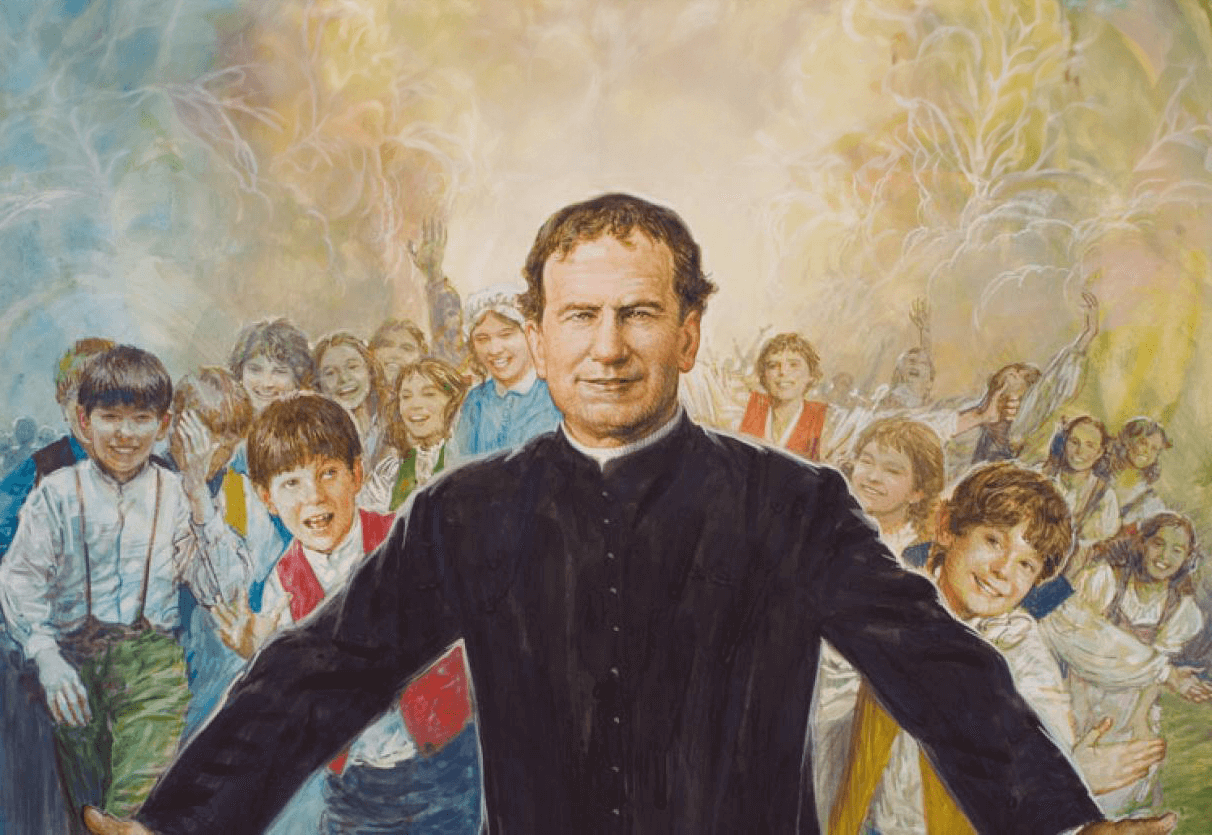
In painting, one of the most famous depictions is the one created by Tommaso Lorenzone in 1868, showing Don Bosco in prayer before Our Lady Help of Christians. In sculpture, one of the most striking statues stands in Piazza Don Bosco in Rome, depicting the saint holding a young boy's hand. Another statue, created in 1934 by the artist Gaetano Cellini, stands at the entrance of the Basilica of Mary Help of Christians. In literature, Don Bosco wrote several books, including "Biographical Memoirs", in which he recounts his experiences with the young people of Turin and explains his teaching method based on reason, religion and affection. Among the most famous biographies is "Don Bosco and His Time" by Giovanni Battista Lemoyne, which traces the saint's life in detail.