January 29: Saint Gildas's Day
Céline Arétin, culture, women's issues and environment correspondent, January 29, 2025
Who was Saint Gildas?
Saint Gildas, known as Gildas the Wise, is a figure of Celtic Christianity, born around 500 AD, probably in Scotland or Wales. His main work, De Excidio et Conquestu Britanniae, harshly criticizes the British kings of his time for their corruption, notably Maelgwn Gwynedd, a powerful Welsh ruler. At Rhuys, in Brittany, he established a monastery famous for spreading Christianity in Armorica. Churches bearing his name are numerous, such as the church of Saint-Gildas-de-Rhuys in Brittany, where he is venerated as patron saint.
Miracles associated with Saint Gildas
It is said that Saint Gildas calmed a storm while crossing the sea to reach Brittany, thereby saving his crew. At Rhuys, he is said to have made a spring of drinking water burst forth by striking the ground with his staff to help the local inhabitants who were suffering from drought. This spring, located near the church of Saint-Gildas-de-Rhuys, is still visited today by pilgrims for its supposed miraculous properties.
Official recognition of Saint Gildas
In 1349, a charter from Jean de Montfort confirmed the abbey's role in promoting the cult of Saint Gildas. Among the relics associated with this cult is Saint Gildas's pastoral staff, kept at the abbey of Saint-Gildas-des-Bois, in Loire-Atlantique. In 1846, Pope Pius IX formalized this regional devotion by authorizing the inclusion of his feast day in the liturgical calendar of several Breton dioceses.
Saint Gildas in art and literature
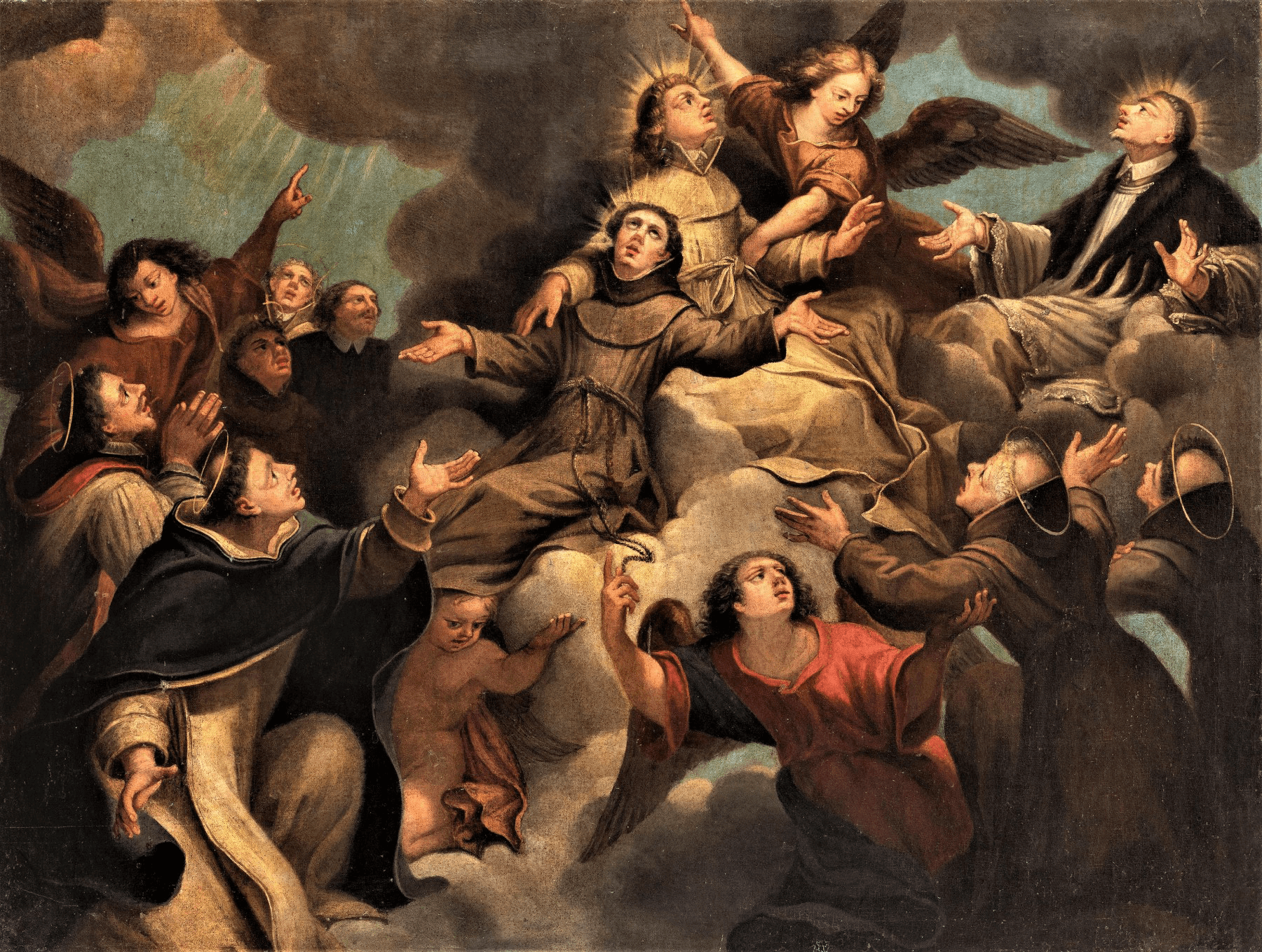
In the abbey church of Saint-Gildas-de-Rhuys, a 17th-century fresco depicts him as a monk with a book and a pastoral staff. At Saint-Gildas-des-Bois, a polychrome wooden statue dating from the 16th century shows the saint in a preaching posture, wearing the tonsure typical of monks of his era. In literature, his work De Excidio et Conquestu Britanniae, a text critical of the rulers of post-Roman Britain, is one of the earliest historical writings of Western Europe and influenced Geoffrey of Monmouth in writing his famous Historia Regum Britanniae. The latter, in turn, laid the foundations for Arthurian legend, incorporating Saint Gildas into the genesis of Breton legends. Closer to our time, the Breton poet Auguste Brizeux evokes Saint Gildas in his poems as a figure of wisdom. Finally, in sculpture, a granite statue dating from the 15th century adorns the chapel of Locmariaquer, depicting Gildas preaching, while stained-glass windows in Quimper Cathedral retrace episodes of his life, such as his crossing of the sea toward Brittany.