February 9: Saint Apollonia's Day
Céline Arétin, culture, women's issues and environment correspondent, February 9, 2026
Who was Saint Apollonia?
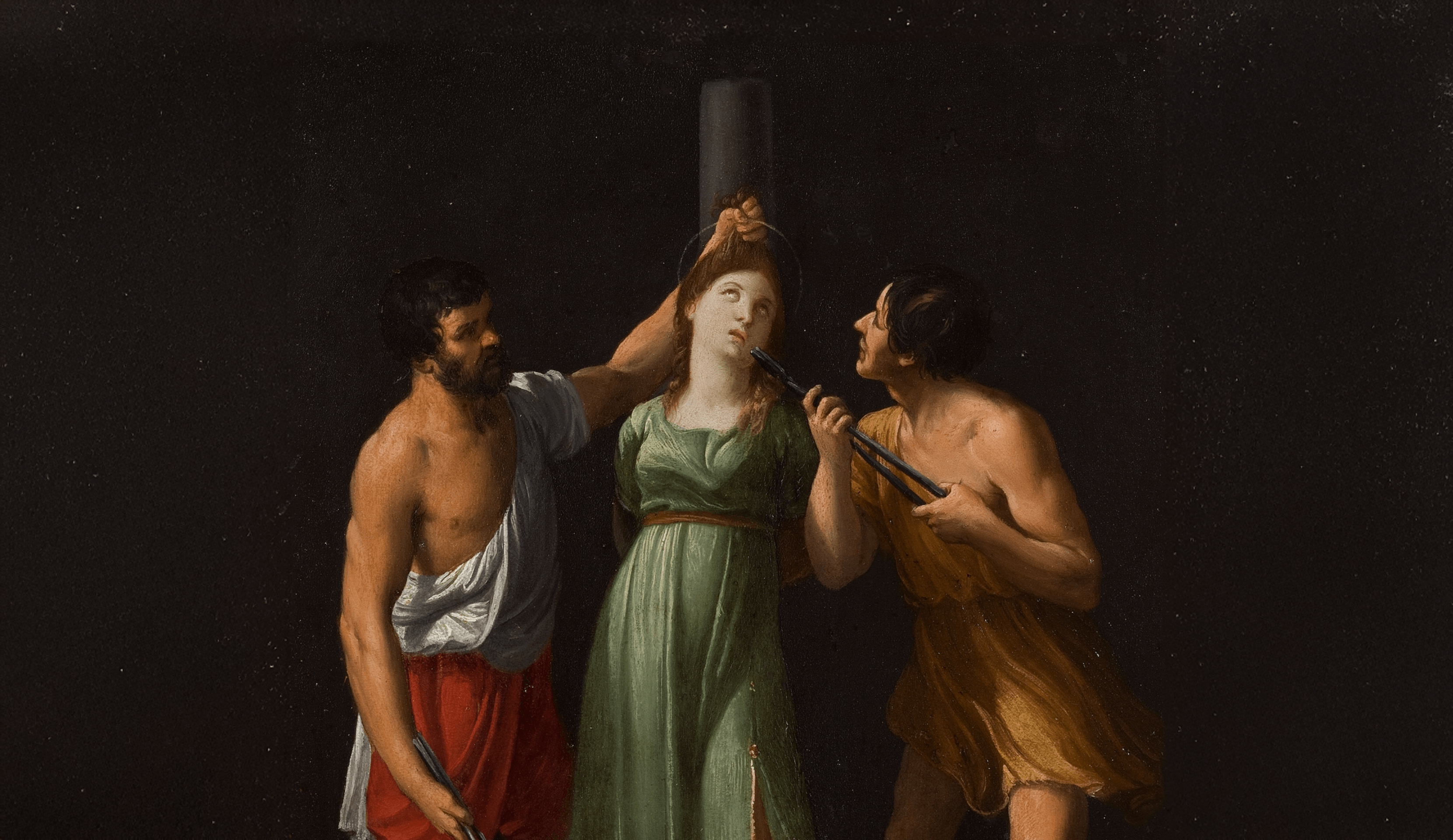
Saint Apollonia was a 3rd-century Christian martyr from Alexandria, Egypt. During the anti-Christian persecutions under Emperor Decius in 249, she was arrested by a pagan mob. According to Dionysius of Alexandria, an eyewitness to her ordeal, she was violently beaten, and her teeth were broken one by one with stones before being completely pulled out. Her tormentors then lit a bonfire in a public square, probably near the Serapeum of Alexandria. They gave her a choice: renounce her faith or be burned alive. Rather than yield, she leapt into the flames, preferring martyrdom to apostasy. Her ordeal, marked by the extraction of her teeth, makes her the patron saint of dentists and of all those suffering from dental pain.
Celebrations and popular traditions
In Alsace, in the 19th century, there was a custom called "Apollonia's tooth": farmers made small amulets from ox bone, which they buried near their houses to ward off dental pain in their family. In Spain, in the city of Valencia, the faithful still drink "Agua de Santa Apolonia" today, holy water believed to protect against dental infections.
Official recognition of Saint Apollonia
Saint Apollonia was recognized as a martyr as early as the 3rd century by the Christian Church, thanks to the writings of Dionysius of Alexandria, who recounts her ordeal in a letter addressed to Pope Fabian. In 1586, Pope Sixtus V made her feast official on February 9 and included her in the Calendar of Saints. She was later confirmed as patron saint of dentists by Pope Clement VIII in 1599. Her cult was strengthened in the 17th century, when the Confraternity of Dental Surgeons of Paris officially chose her as their protector and organized an annual Mass in her honor at the church of Saints Côme and Damien.
Saint Apollonia in art and literature
Among the most famous works is a painting by Francisco de Zurbarán (1636), kept at the Museum of Fine Arts in Boston, in which she is depicted in a red robe, holding pincers and a palm branch. In Venice, in the church of San Stae, a baroque fresco by Giovanni Battista Tiepolo (1737) depicts her ordeal. In France, a 16th-century wooden statue, visible in the church of Saint-Maclou in Rouen, shows the saint holding a golden molar. At Notre-Dame de Paris, a bas-relief on the south portal depicts her with an expression of serenity. In Bruges, in the church of Notre-Dame, a 14th-century statue shows the saint having a tooth pulled by her tormentors. In literature, the Benedictine monk Jacobus de Voragine devotes a passage to her in his famous Golden Legend (13th century), in which he details her ordeal. In the 19th century, the poet Charles Baudelaire refers to her ordeal in a passage from My Heart Laid Bare, in which he compares existential pain to the pulling out of teeth.