April 4: International Mine Awareness Day
Manuel Van den Broucke, sports, society and politics correspondent, April 4, 2025
The Ottawa Treaty
The Ottawa Treaty, officially known as the Convention on the Prohibition of Anti-Personnel Mines, came into force in 1999 with the goal of completely banning the use, production, stockpiling and transfer of anti-personnel landmines. To date, 164 countries have ratified the convention, committing to destroy their existing stockpiles and clear mined territory. Since its adoption, more than 55 million stockpiled anti-personnel mines have been destroyed worldwide, and at least 31 countries, including France, Colombia and Algeria, have declared their territory fully cleared. However, several major producer and user countries, including the United States, Russia, China, India and Pakistan, have still not signed the treaty.
The Countries Most Affected by Landmines
Each year, according to the Landmine and Cluster Munition Monitor, around 5,000 people fall victim to these devices, nearly 80% of them civilians, often children. More than 60 countries are still contaminated by these weapons, including Afghanistan, Angola and Cambodia, where around 64,000 victims have been recorded since 1979. In Afghanistan, more than 18 million mines still threaten civilians, causing around 1,500 casualties every year. Colombia, despite the 2016 peace accords, has recorded more than 11,000 victims since 1990. Syria, after more than a decade of civil war, has nearly 12 million people exposed to these explosives, with around 2,700 victims between 2018 and 2022. In Yemen, the ongoing war has led to the massive spread of anti-personnel mines, with around 1,400 victims recorded every year since 2015.
How Do Anti-Personnel Landmines Work?
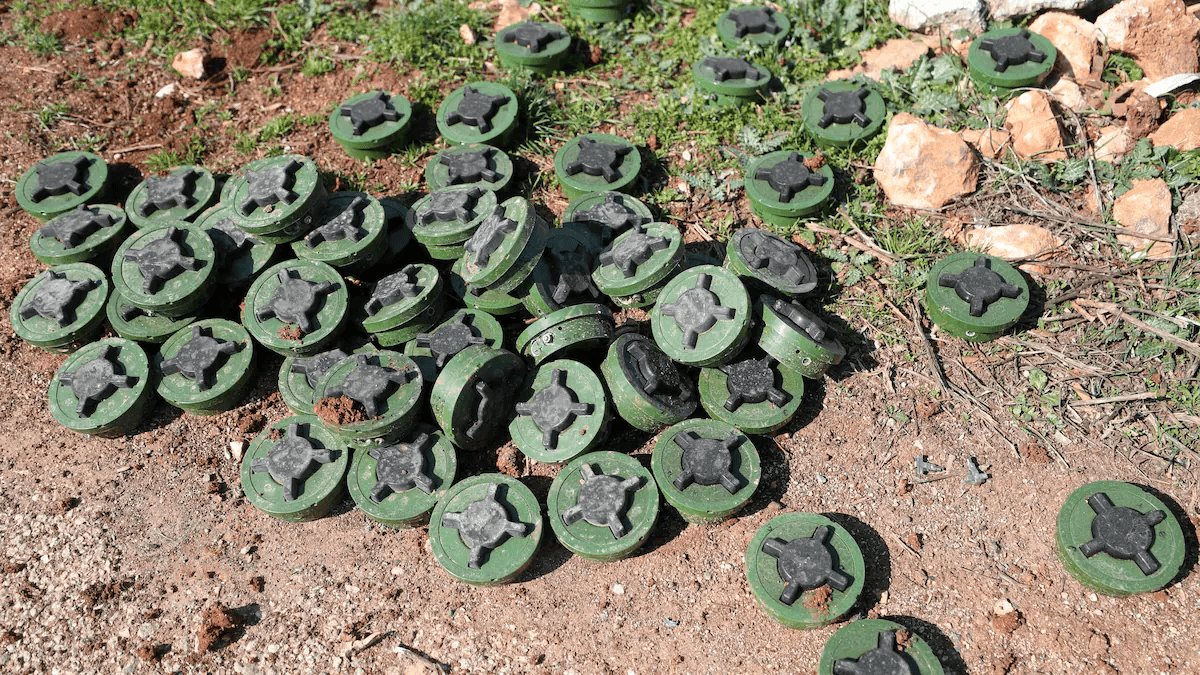
Anti-personnel landmines are explosive devices designed to kill anyone who steps on them. They are triggered by a pressure-sensitive mechanism, generally activated by 5 to 15 kg of pressure. Once triggered, an explosive charge sends metal fragments flying, causing severe injuries to the legs or the whole body. The PFM-1 mine, also known as the "butterfly mine," used notably by the Soviet Union, was designed to be dropped from aircraft and scattered over large areas. The well-known American M14 mine, a small plastic mine nearly undetectable by conventional metal detectors, contains around 29 grams of explosive and can tear off a foot when stepped on.
Demining Methods
The manual method remains the most widely used: deminers equipped with metal detectors move forward slowly to locate and then neutralize each mine individually. Another technique involves mechanical equipment, such as the armored "MineWolf" vehicle, which tills the ground and destroys buried mines. Some countries also use specially trained dogs, capable of detecting explosives through their sense of smell.