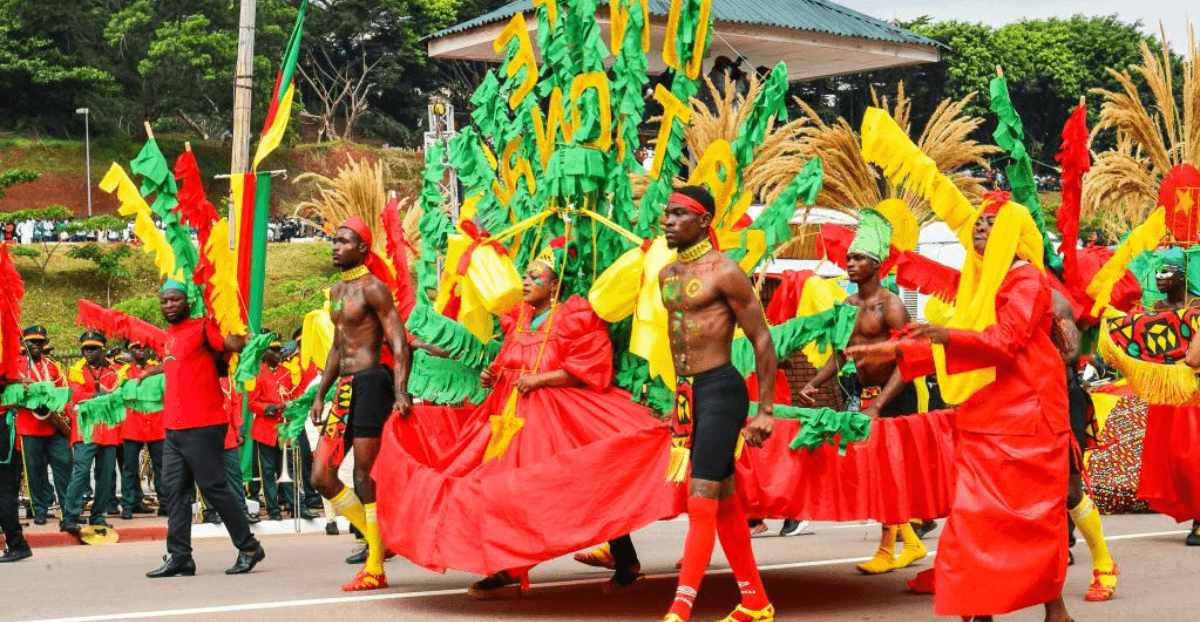
May 20: Cameroon National Day
Ingrid Nováková, international specialist, May 20, 2025
From pre-colonial kingdoms to the slave trade
Before the Europeans arrived, the territory of present-day Cameroon was a crossroads of Sudanese, Bantu and Guinean cultures. On the coast, the Duala city-states had controlled the river trade in wood and ivory since the 16th century, and increasingly the trade in captives. The 1472 Portuguese expedition, which named the river "Rio dos Camarões," opened the way for European traders. The Dutch, British and French then entrusted the coastal kings with supplying enslaved people. Between the 17th and 19th centuries, an estimated one and a half million people were deported from the Bight of Biafra. After the abolition of the Atlantic slave trade (1807-1833), the Duala elites signed "treaties of friendship" banning the sale of human beings and redirected the economy toward palm oil and rubber.
German, then Franco-British colonization
On July 12, 1884, Duala chiefs signed an agreement placing Cameroon under German control. The German army (Schutztruppe) violently suppressed revolts by several peoples, notably the Bakossi and the Bassa. Yaoundé, initially just a scientific outpost, became the capital in 1909 after a railway was built between Douala and Nkongsamba. During the First World War, the French and British jointly attacked Cameroon, then a German colony. In 1916, the German troops were defeated. In 1919, the League of Nations entrusted the administration of Cameroon to France and the United Kingdom.
From independence to the modern Cameroonian state
On January 1, 1960, Cameroon became independent with Ahmadou Ahidjo as president. On October 1, 1961, the part of Cameroon previously administered by the British (Southern Cameroons) joined the country, forming a two-government federation. On May 20, 1972, a referendum transformed this federation into a unitary state, and in 1982 Paul Biya became president. After a coup attempt in 1984, his hold on power grew stronger. In 1990, a new law expanded political freedoms and allowed the opposition to take part in elections. The 1996 constitution created a Senate and gave regions more power, but a 2008 reform allowed Biya to run for re-election without term limits.
See also: History of Cameroon's National Day